
Introduction to Philosophy Syllabus for 2011-2012
Return to Syllabus List
Instructor Information
Instructor
(Curriculum Vitae)Phone
Phone number not availableOffice Location
Office Hours
Course Information
Recording Policy
Disability Statement
Any student who, because of a disabling condition, may require some special arrangements in order to meet course requirements should contact disAbility Services (Student Service Center room 119, phone 371-5436) as soon as possible.
Statement for Mental Health and Advocacy & Resource Center:
As a student you may experience a range of issues that can cause barriers to learning, such as strained relationships, increased anxiety, alcohol/drug problems, feeling down, difficulty concentrating and/or lack of motivation. These mental health concerns or stressful events may lead to diminished academic performance or reduce a student's ability to participate in daily activities. Amarillo College offers services to assist you with addressing these and other concerns you may be experiencing. If you or someone you know are suffering from any of the aforementioned conditions, you can learn more about the broad range of confidential mental health services available on campus by calling the AC Counseling Center at 806-371-5900. The AC Counseling Center website is https://www.actx.edu/counseling/ . Also, if you are in need of social services (affordable housing, utilities, transportation, food, clothing, childcare, medical/dental/vision, legal), please call the AC Advocacy & Resource Center at 806-371-5439. The AC Advocacy & Resource Center website is https://www.actx.edu/arc
Amarillo College Tutoring for Success Policy:
Administrative Drop Policy
N/A
Student Withdrawal Procedures
N/A
Privacy Statement
The Amarillo College Privacy Policy is found at https://www.actx.edu/-amarillo-college-privacy-notice , and applies to all Amarillo College students. If you have questions about this privacy statement or you believe that your personal information has been released without your consent, send email to humanresources@actx.edu .
Course
PHIL-1301-001 Introduction to Philosophy
Prerequisites
20 semester hours or instructor consent
Course Description
Various branches of philosophy - the nature of goodness, freedom - and certain basic problems within each branch. Designed to introduce the student to philosophical thinking.
Student Resources Student Resources Website
Department Expectations
\N
Occupational License Disclaimer
Hours
(3 sem hrs; 3 lec)
Class Type
On Campus Course
Syllabus Information
Textbooks
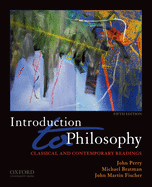
Perry, J., Bratman, M., & Fischer, J. M. (Eds.). (2010). Introduction to Philosophy: Classical and Contemporary Readings (5th ed.). New York: Oxford University Press.
ISBN-10: 0195112040
ISBN-13: 978-0195112047
Additional reading assignments not in the textbook will be made available to students either through library reserve or on the AC Online course website.
It is strongly recommended, though not required, that each student purchase a philosophy dictionary, or at the very least make use of one of the following online philosophy dictionaries:
Stanford Encyclopedia of Philosophy
Dictionary of Philosophy
http://www.ditext.com/runes/index.html
Philosophy Pages Dictionary
http://www.philosophypages.com/dy/
The use of Wikipedia is NOT recommended, and is discouraged.
Supplies
The student is responsible for supplying any materials required to take notes during lecture, whether that be traditional pen or pencil and paper or an electronic device such as a laptop or an e-tablet. Recording devices are not permitted without pri
Student Performance
Description (ACGM): Introduction to the study of ideas and their logical structure, including arguments and investigations about abstract and real phenomenon. Includes introduction to the history, theories, and methods of reasoning.
Student Learning Outcomes (Exemplary Educational Objectives)
Student learning outcomes are based on required Core Curriculum Intellectual Competencies, Perspectives, and Exemplary Educational Objectives as defined by the Texas Higher Education Coordinating Board. Specific Course Requirements are to be found in the course schedule and course syllabus.
Learning Outcomes for Philosophy: CCIC 1, 2, 3, 4, 5 CCP 1. 2. 5. 7. 8 EEOSB 1, 2, 4, 5, 9, 10, 12
1. To understand the appropriate methods, technologies, and data that social and behavioral scientists use to investigate the human condition.
2. To identify and demonstrate an understanding of the main categories of philosophy (such as metaphysics, logic, epistemology, and axiology).
3. To identify and analyze the origins, historical, social, and cultural emphasis of philosophical inquiry.
4. To demonstrate an understanding of the principle characteristics which define areas of philosophy through a presentation of critical analysis.
5. To recognize and apply reasonable criteria for the acceptability of historical evidence and social research.
5. To analyze, critically assess, and develop creative solutions to philosophical problems.
7. To identify and understand differences and commonalities within diverse cultures.
Students Rights and Responsibilities
Student Rights and ResponsibilitiesLog in using the AC Connect Portal
In order to receive your AC Connect Email, you must log in through AC Connect at https://acconnect.actx.edu .
If you are an active staff or faculty member according to Human Resources, use "Exchange". All other students, use "AC Connect (Google) Email".
Expected Student Behavior
Students are expected to conducted themselves in a professional and responsible manner. This means that each student should arrive at lecture on time, stay for the entire lecture (unless early departure is approved by the instructor), and be prepared for that day's lecture. Being prepared entails having read the day's assignment and handing in any assignment that might be due for the day, as well as participating in relevant class discussion. In addition, students should have necessary means for taking notes during lecture, whether that be on an electronic device (i.e., computer) or with traditional paper and pen (or pencil). Also, students during exam periods are responsible for supplying their own Blue Books.
Students who engage in any disruptive or abusive actions during the course may be subject to disciplinary action. The student is expected to treat the instructor and his/her fellow students with respect at all times during the course.
Computer Usage Policy: Students are expected to have access to a computer for certain assignments (e.g., term-paper). Students are welcomed to bring their computers (e.g., laptops, tablets) to lecture as long as their use is not disruptive to the student's or other students' learning. All use of the computer during lecture should be relevant to the lecture environment. Instant messaging, random web surfing, playing games, or other use deemed inappropriate is not permitted. Computer sounds must be muted during lecture. Using a computer to record a lecture is covered below under recording devices policy.
Cell/Mobile Phone Policy: Unless permission is otherwise granted by the instructor prior to lecture (in cases of emergency), all cell/mobile phones must be either switched off or to silent (NOT vibrate) during lecture periods. Texting, making or receiving calls during a lecture is not permitted.
Recording devices: Use of any type of recorder during a lecture is not permitted without prior approval from the instructor. If permission is granted for recording, certain limitations on that recording's use may apply. Please consult with the instructor regarding this.
Office hours and tutorial sessions: Students have the responsibility of learning the class material to perform sufficiently on course assignments and tasks. If students have a problem with understanding the class material, it is their responsibility to ask questions in lecture (if relevant) , and/or see the lecturer during office hours, and/or set up an appointment with the instructor to receive additional instruction at another time. If necessary, it is also the student's responsibility to seek outside tutorial help as needed.
Academic Honesty: Any instances of cheating, plagiarism, collusion, fabrication, etc. will be fully investigated and may be just cause for disciplinary action. All violations will be forwarded to the proper college authorities for review. Information on plagiarism (and how to avoid it) may be found on the Amarillo College Library website at http://www.actx.edu/library/index.php?module=article&id=118
Grading Criteria
All student assignments submitted to the instructor will be expected to be legible, readable, and use proper rules of spelling and grammar. It is the student's responsibility to complete all assigned tasks by the specified due date.
Any assignment turned in using "text-speak" will not be graded.
Term papers must be type-written using proper spacing (1.5 or double-spaced), pagination (one-sided with default word processor margins), format (style), and font (11-12 pt) as prescribed by the instructor. Proper instructor described reference materials and citation formats (APA) must be used for term paper. Term papers must be handed in on the required date. Term papers will be graded on content, grammar, style, and whether the above instructions were followed. Late term papers may incur grade penalties at the discretion of the instructor.
Any instances of cheating or plagiarism will result in a failing grade.
Grades will be assigned on the traditional letter and 100 point scale.
| 89.5 -100 | A |
| 79.5- 89.4 | B |
| 69.5 - 79,4 | C |
| 59.5 - 69.4 | D |
| 0 - 59.4 | F |
RTPs (Researh Topic Papers will be graded on a check point system as follows (x's have been substituted for checkmarks in this example):
| X++ | 100 | A |
| X+ | 90 | A |
| X | 80 | B |
| X- | 70 | C |
| X- - | 60 | D |
| 0 (marked zero) | 0 | F |
No late RTPs (Research Topic Papers) will be accepted, and thus a grade of zero will be recorded for RTPs not handed in on time.
Any late exams or papers will only be approved by the instructor at his discretion. If the student is previously aware of any absences that might affect his/her ability to turn in a paper or take an exam, it is his/her responsibility to notify the instructor as soon as possible, as this might affect the instructor's decision to accept late work. Extended absences may require proper documentation (e.g., doctor's note) to make up missed assignments (excluding RTPs).
| Reaserch Topic Papers (RTPs) (5 lowest grades will be dropped) | 25% |
| Midterm Exam | 25% |
| Research (Term) Paper | 25% |
| Final Exam | 25% |
Additional information will be provided to students by the instructor regarding RTPs, exams, and research papers during the course.
Extra Credit MAY be assigned during the course at the discretion of the instructor.
Grading Criteria is subject to change at the instructor's discretion.
Attendance
There is no mandatory attendance policy for this course. Students should be aware, however, that failure to attend lectures and hand in regular assignments will impact their grade for the course. Therefore, though regular attendence is not mandatory, it is strongly recommended.
Calendar
Listed below is the order of readings and lectures for the course. Since the amount of discussion on each reading may vary, it is impossible to give an exact date that each will be covered, thus the below is only a general guide. Research Topic Papers (RTP)--a one paragraph, one page summary of the overall argument in the readings--is required for each reading unless otherwise noted. This reading schedule is subject to change at the discretion of the instructor based on the needs of the course. The dates for the Midterm Exam and the due date for the Research Term Paper will be set during the course. The Final Exam for the course will be one day between December 5-9th (final day and time yet to be determined).
Week 1:
Syllabus
Introduction: On the Study of Philosophy (pp. 3-8) (NO RTP)
Logical Toolkit (pp. 9-17) (NO RTP)
Russell: The Value of Philosophy (pp. 18-21)
Weeks 2-4:
Meditation I (pp. 136-138)- Descartes deals with skepticism and doubt:
Grau: Bad Dreams, Evil Demons, and the Experience Machine: Philosophy and The Matrix. (pp. 160-167)
Hume: An Enquiry Concerning Human Understanding; Sections IV and V (pp. 193-205)
Salmon: The Problem of Induction (pp. 217-238)
Goodman's New Riddle of Induction (pp. 816-817): The Blue-Grue Paradox. (NO RTP)
Weeks 5-7:
Introduction to Research (AC Library)
Meditation II (pp. 138-141) - Descartes deals with the nature of the mind and identity:
Introduction: Minds, Bodies, and Persons (pp. 239-247) (NO RTP)
Ryle: Descartes' Myth (pp. 251-258)
Armstrong: The Nature of the Mind (pp. 259-266)
Dennett: Intentional Systems (pp. 267-279)
Dennett: Where am I? (pp. 383-391)
Perry: A Dialogue on Personal Identity and Immortality (pp. 326-346)
Nagel: Death (pp. 806-810)
Hodge: Why Immortality Alone will Not Get me to the Afterlife. (ACOnline accessible; pp: 395-410)
MIDTERM
Weeks 8-9:
Meditation III (142-147): Descartes deals with God's existence
Anselm: The Ontological Argument (pp. 42-43)
Aquinas: The Existence of God (pp. 44-46)
Paley: Natural Theology (pp. 46-51)
Pascal: The Wager (pp. 51-55)
Flew, Hare, & Mitchell: Theology and Falsification
http://www.politik-salon.de/files/theory_of_falsification.pdf
Russell: Why I Am Not a Christian (pp. 55-58)
Weeks 10-12:
Meditation IV (147-151): Descartes deals with Truth and Falsity:
Plato: Theaetetus (pp. 126-133)
Gettier: Is Justified True Belief Knowledge? (pp. 133-135)
Nozick: Excerpt from Philosophical Explanations (pp. 168-175)
Butchvarov: The Limits of Ontological Analysis (Link to paper provided on ACOnline; pp. 3-37)
Weeks 13-15:
LAST DAY TO WITHDRAW: NOVEMBER 16
Meditations V-VI (151-160)
Hume: Of Skepticism with Regard to the Senses (pp. 176-190)
Searle: Minds, Brains, and Programs (pp. 298-310)
Nagel: What Is It Like to Be a Bat? (pp. 311-319)
Jackson: What Mary Didn’t Know (pp. 320-323)
Churchland: Eliminative Materialism (pp. 380-384)
TERM PAPERS DUE
Week 16:
Final Exam
The above calendar is subject to change due to unexpected situations. It is the student's responsibility to check online email and announcements or all other forms of communication issued by the instructor.
Additional Information
Accessing ACOnline: It is the student’s responsibility to check email and the Announcement section for information regarding any changes for class. Students will submit all assignments and analyses using ACOnline unless noted on the assignment or by the instructor.
Syllabus Created on:
11/30/-1 12:00 AM
Last Edited on:
11/30/-1 12:00 AM