
Events
Tours & Hands-On STEM Experiences
From tours to community greenhouse sales, the STEM Research Center is a place to explore, connect, and grow.
Schedule Tours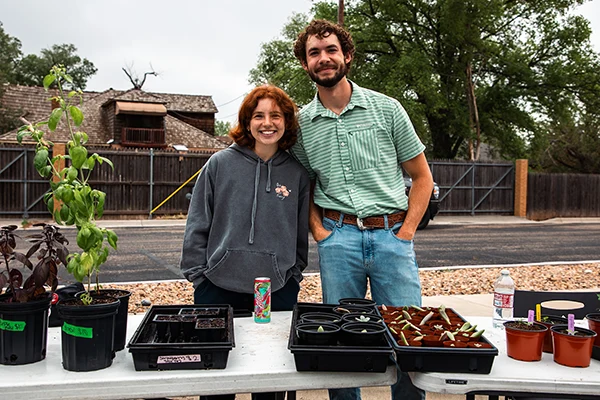
School Visits & Demonstrations
Bring your class, camp, or group for a guided tour of the Research Center and Greenhouse, plus optional hands-on activities for a full STEM learning experience.
Quick Facts
- 30 - 60 minute visit
- Hands-on activities available
- Designed for K–12 & community groups
Activities
Demos at AC's STEM Research Center and Greenhouse give guests a firsthand look at the equipment used in some of the research conducted in the facility along with the opportunity to talk directly with some of the projects' principal investigators (if available).
Check out the list of available activities/lessons that can be incorporated into your visit. Some activities require prep time, which requires advance scheduling. Other activites might be too complicated for younger groups or less exciting for older ones. Prep times and suggested age groups are listed next to the respective activity. Fill out the AC STEM Research Center Tour Request Form to schedule your group!
All Ages
20 – 40 minutes
The Munsell System is a standardized method for identifying soil color using hue, value, and chroma. Soil samples are compared to color chips to record an exact notation, such as 10YR 5/3. This system helps students and scientists describe soils consistently and is used in fields like archaeology, soil surveys, criminal investigations, and even carpet manufacturing.
Middle School and Older
30 – 45 minutes
Soil texture describes the proportions of sand, silt, and clay, and is considered one of the most important soil properties because it affects water movement, gas exchange, and plant nutrition. While lab analysis is costly, soil texture can be accurately estimated in the field by feel.
All Ages
10 – 15 minutes
This demonstration introduces students to the different media used in hydroponic and aquaponic systems. Since one greenhouse bay is dedicated to these growing methods, the activity can naturally transition into a tour of that space.
All Ages
5 minutes
Requires 2 – 3 weeks prep
Microgreens are basically the seedlings of edible herbs and vegetables and can be grown with or without soil. Visually pleasing, students can pluck a few and taste them for themselves!
All Ages
10 – 20 minutes
Students can choose from a variety of seeds to sow and can write the care instructions on a note card to take home. They would sow them in Dixie cups that they labeled and could be placed in a paper bag to carry back
All Ages
20 – 40 minutes
Requires 3 – 4 week prep time
Once a seedling is ready to move to a larger container, students will be taught how to handle the fragile plant and how to properly move it from one container to another. The pot they would transplant to is still small enough to fit into a paper bag. Similar to the “planting seeds” activity, they can write care instructions on a note card and can take their transplanted seedling home.
2nd Grade and Younger
10 – 20 minutes
The natural pigments in plants have been used for thousands of years in art creation. Students can use a mortar and pestle to grind plant material with a small amount of solvent to create their own pigments to use for coloring a picture.
All Ages
15 – 30 minutes
Students observe samples up to 7.5X zoom magnification. This is a lower magnification than the compound microscopes but allows for a less supervised hands-on experience. Samples for observation include insects, plant life, gems, jewelry, or electronic parts. This can allow students to get creative and think of something they might want to see up close.
Demonstration
All Ages, 10 – 20 minutes
Looking at Elodea (aquatic plant) through 40X, 100X, 400X and 1000X magnification to see the dynamics of individual chloroplasts within the plant cells. This is a demonstration that students would be able to watch on the TV (direct connection of instructor microscope to TV).
Prepare a Wet Mount
Middle School and Older, 10 – 20 minutes
The Wet Mount is a procedure performed in the laboratory to observe both motile and non-motile organisms/substances. Examples include pond water or small pieces of paper (newspaper)
Simple Stain
High School, 30 minutes
Using either plant cells (onion is a good option) or cheek cells on a slide, then adding a stain to slide to observe cell morphology.
All Ages
10 – 15 minutes
Fourier-transform infrared spectroscopy is an analytical technique used to obtain the infrared spectrum (absorption or emission) of a solid, liquid or gas. When infrared radiation is directed towards a sample, that sample will absorb some of the radiation and some will be transmitted (passes through). Based on that information, we can determine the exact chemical composition of the sample.
All Ages
Feel free to bring your lunches and enjoy our outdoor learning space! We have two 4-bench picnic tables and another long bench in front of the pond. Depending on class size, some might have to sit on the sidewalk.
We also have a pond with koi and goldfish that guests can feed during warmer months. The fish are not fed during the cooler months.
Community Events
Upcoming Events
Come visit the SRC!
| 4th Annual Farmers Market | May 6, 2026 – 9:00 AM-12:00 PM |
| Laboratory Open House | TBA |
Amarillo College STEM Research Center
2217 S. Van Buren St.
Amarillo, TX 79109
Hours of Operation
Monday to Friday: 8:00AM - 5:00PM
Weekends: Closed
The Stem Research Center follows Amarillo College hours and closures.